

Guidance to your body’s deepest wisdom
Seeing dis-ease as a messenger NOT an enemy
InBody Psychology specialises in healing chronic disease states by uncovering the emotional patterns lying at the core of physical symptoms. Using a unique blend of schema-focused therapy, Internal Family Systems and Hakomi body-focused therapy we create a space where you can listen and respond to the messages your body sending to gain lasting relief, healing and health.
Dr Hatton has 17 years of experience developing her integrative approach using various therapies, grounded in a deep understanding of the mind-body connection. This approach has been proven effective across a wide range of diverse clients from adolescents to mature adults.
What is integrative health psychology
Integrative Health Psychology™ is a term coined by Ileana to describe a method of treatment that goes beyond traditional talk therapy to address the multitude of factors affecting mental health. Specifically, the influence of the gut-brain connection including nutritional and hormonal imbalances, the microbiome, markers of inflammation, the epigenetic effects of intergenerational trauma, interoception and somatic memory.
At InBody we are known for being able to make progress in cases other therapists haven’t been able to. We do this by employing treatments that are founded on scientific research, with a broad holistic approach which draws upon a range of modalities to provide the most successful outcomes.
Each one of us is an interconnected web of memories, stories, interfamilial trauma patterns, nervous system responses. Lasting and effective treatment of our issues must address all of these components as a whole.

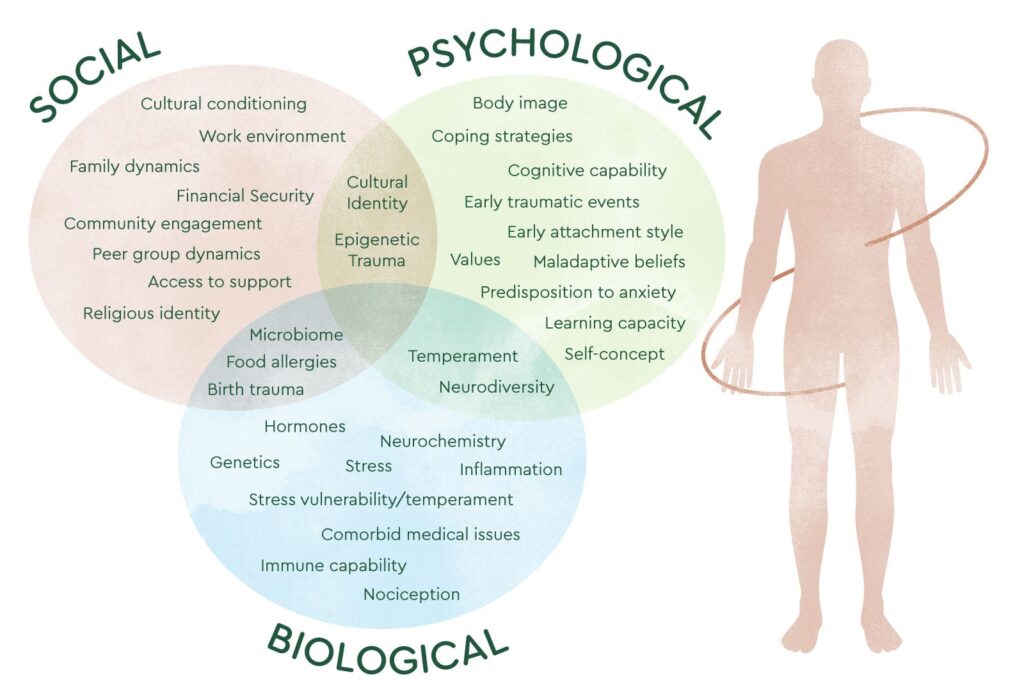
Grounded in the Biopsychosocial Model of Chronic Disease
To explain the multifactor system which underlies chronic disease we developed a new model which outlines how this works.
We believe that true healing begins when you understand why you’re feeling what you’re feeling, and are empowered with the tools to respond differently. By listening to your body’s innate intelligence, you can unlock profound self-awareness and embark on a path toward lasting well-being.
The Biopsychosocial model of chronic disease is built upon the Biopsychosocial model but including additional factors often specific to chronic illnesses to offer a new perspective of the factors that maintain health problems, unexplained pain, recurrent infections, inflammatory conditions. There is a number of factors that even when people get intervention remain unaddressed and will continue to feed the root cause of the problem.
We offer a comprehensive model and intervention approach to address the underlying unconscious patterns that give rise to dis-ease and health issues. We do not purport to treat everything but here are some examples of illness we have had significant results with.
Why Inbody Psychology?
At InBody Psychology we help you decode the messages your body is sending. We work to close the gap between your mind and body. This understanding is the first crucial step towards true and lasting healing.
Sessions are a collaborative and compassionate exploration, designed to illuminate the hidden connections within you. We integrate powerful, evidence-informed modalities including:

Body-centered therapy
Through applied mindfulness, you start to attune to your body’s sensations, postures, and movements. This allows you to access and process experiences that often have no words, leading to profound release and integration of unresolved trauma related to early attachment, birth or inter-generational traumas.

Contacting repressed emotion
We specialize in helping you understand how emotional distress, stress, and past experiences can manifest as physical symptoms. This perspective can be a game-changer for those dealing with chronic pain, fatigue, and other persistent conditions, including fertility and reproductive issues, where the mind-body link is often overlooked.

Addressing Early Attachment Patterns
Early experiences with caregivers can deeply shape how we relate to ourselves, others, and our well-being. We gently explore these foundational patterns, helping you to re-pattern old responses and build a more secure internal foundation, which is vital for healthy relationships and navigating life’s challenges.

Hakomi & Somatic Awareness
Through gentle, mindful, body-centred techniques, we help you uncover core beliefs and automatic reactions that may be driving your distress. This experiential work fosters deep self-discovery in a safe and compassionate space, supporting you through periods of transition or when addressing complex emotional and physical issues.
Chronic illnesses we offer treatment for
Endometriosis
Effective treatment often requires a multi-system approach addressing hormone dysregulation (ie. oestrogen dominance), bacterial overgrowth (SIBO, dysbiosis), nutrient maladsorption and inflammatory factors as well as changing underlying maladaptive core beliefs which keep symptoms repeating or returning.
Difficult falling pregnant or repeated miscarriage
Addressing chronic inflammation, overactive immune system, nervous system dysregulation through diet and microbiome balancing. Addressing emotional blocks including ambivalence around pregnancy, limiting unconscious beliefs or attachment wounds that may inhibit conception or maintaining a pregnancy.
PCOS
Identifying the type of PCOS, addressing thyroid or liver issues, dietary changes to balance insulin. Psychologically, dealing with repressed emotions (especially anger) and limiting childhood beliefs internalised about being a woman or a fertile woman, blocked creative energy and direction in life path. Exploring re-connecting to cyclical flow of nature, the seasons, and phases of the moon as a way to organise life in line with your bodies rhythm.
Adenomyosis
Linked to deep-seated blocks in the pelvic energy. May require adjunct methods such as acupuncture, pelvic massage, visualisation techniques. Decrease excessive insulin and oestrogen, natural progesterone supplementation. Learning to listen to the innate wisdom of our pelvic energy and getting in touch with personal needs and not subjugating our needs to those of others. Learning healthy assertiveness and respect for ourselves, addressing self-worth issues.
Thyroid problems (Grave’s Disease/ Hashimotos)
Requires addressing intestinal permeability, liver detoxification and metabolic inflammation alongside nervous system overload. Emotional factors can include a history of suppressing underlying needs and authentic self, feelings of shame/ humiliation.
Premenstrual Dysphoric Disorder
Often requires addressing oestrogen dominance and allowing space for the emotional baggage that comes up for reflection pre-menstrually (luteal phase).
Chronic pain
Chronic pain that continues when no clear pathology can be identified can be traced back to how the body “holds memory” of previous traumatic experiences. Somatic practices that realign us with the pain messages the body is sending often unlocks the clue to what is needed for its release.

About Ileana
I had my own journey of this with Stage 3 endometriosis. However as a result of my effective treatment and recovery from this, I founded Integrative Health Psychology as a means of identifying and targeting these additional factors which can be the hidden key to long-lasting and successful healing.
Dr Hatton studied for 10 years at the University of Sydney. After finishing her study she worked in a variety of settings including private practice, trauma services, Crisis Team, Community Mental Health and internationally for Medecins sans Frontieres. Ileana’s practice is also influenced by a keen interest in deeper understanding of the human experience including Buddhist philosophy, Kabbalah and Jewish mysticism, and ongoing practice in the healing modalities of 5 Rhythms Dance Therapy, Acuenergetics, and Chinese medicine.
What people say
“It’s hard to express in words how much your wise words, direction and endless encouragement have helped guide me through these past few years. It has been a challenging and fulfilling period of personal growth for which I am most grateful. I do feel I’m on the right path and more determined than ever to keep at it. Thank you Ileana for your gentle and gracious manner.”
“Thank you for being such a significant part of my journey, for steadily unpacking my pain with me and for helping me be still long enough to find ME again- mind, body, heart and soul. With your help my smile became a giggle, and is steadily heading for a full-on belly laugh!”
Frequently Asked Questions

What's the difference between a Psychologist, a Clinical Psychologist, and a Psychiatrist?
One of the most widely researched evidence-based therapies, CBT focuses on changing unhelpful thought patterns and unwanted behaviours to improve functioning and well-being.
Do I need a GP referral to see a clinical psychologist?
Instead of trying to control or change difficult thoughts and feelings, ACT helps individuals learn to accept them and shift focus to committed action towards their goals and values. It uses metaphors, mindfulness, and experiential exercises to help clients live a rich and meaningful life by fostering psychological flexibility.
What can I expect from a therapy session?
A behavioural approach that focuses on balancing emotional dysregulation through skills training in 4 different areas: mindfulness, distress tolerance, emotional regulation and interpersonal effectiveness. It is the gold-standard of treatment for Borderline Personality Disorder but has also shown effectiveness for addictions, eating disorders, self-harm behaviour and ADHD.
Do you see people under Worker’s Compensation?
Addresses deeply rooted, long-standing core beliefs (schemas) formed in childhood, helping individuals understand and change how these patterns impact their lives today.
How many sessions do I need?
A technique using bilateral stimulation (eye movements, tapping or sounds) to help process and reduce the impact of traumatic or distressing memories. It is primarily used in the cases of traumatic memory.
Can I get sessions under insurance?
A body-centered (somatic) psychotherapy developed by Ron Kurtz in the 1970’s. Hakomi comes from the native American Indian Hopi language meaning: “where do I stand in relation to the many realms?”. Hakomi therapy operates on the principle that the body holds implicit memories and patterns that influence our present experience. Through gentle, mindful exploration of physical sensations, gestures, and habitual postures, clients can uncover and transform core beliefs that may be limiting their lives. It’s a very experiential and compassionate approach, focusing on non-violence and mind-body holism.
I’m not an Australian citizen, can I still access sessions?
Developed by Richard Schwartz in the 1980’s, IFS views the mind as a “family” of inner “parts” and a core “Self.” It helps individuals contact, honour and heal each of these parts to restore inner harmony and self-leadership.