
PSYCHOLOGIST FOR MEDICAL PRACTICES IN SYDNEY
Psychology support for GPs, specialising in chronic illness

The Clinical Solution for Chronic Illness:
Integrative Health Psychology™
Medical management often addresses the biological symptoms of chronic diseases such as endometriosis, chronic pain, and thyroid disorders, but the psychological and social drivers of the disease—microbiome imbalance, chronic inflammation, altered nociception, and maladaptive core beliefs—frequently remain untreated. This is where patient recovery plateaus.
Based on > 18 years of experience in clinical psychology, lived experience of chronic illness and training in nutritional modalities I have formulated the Biopsychosocial model of Chronic Illness (link).
Integrative Health Psychology is a specialized, biopsychosocial intervention designed to bridge the gap between medical pathology and nervous system recovery and provide a clinical framework for successful outcomes for “treatment resistant” clients.
Our Integrative Health Psychology Program
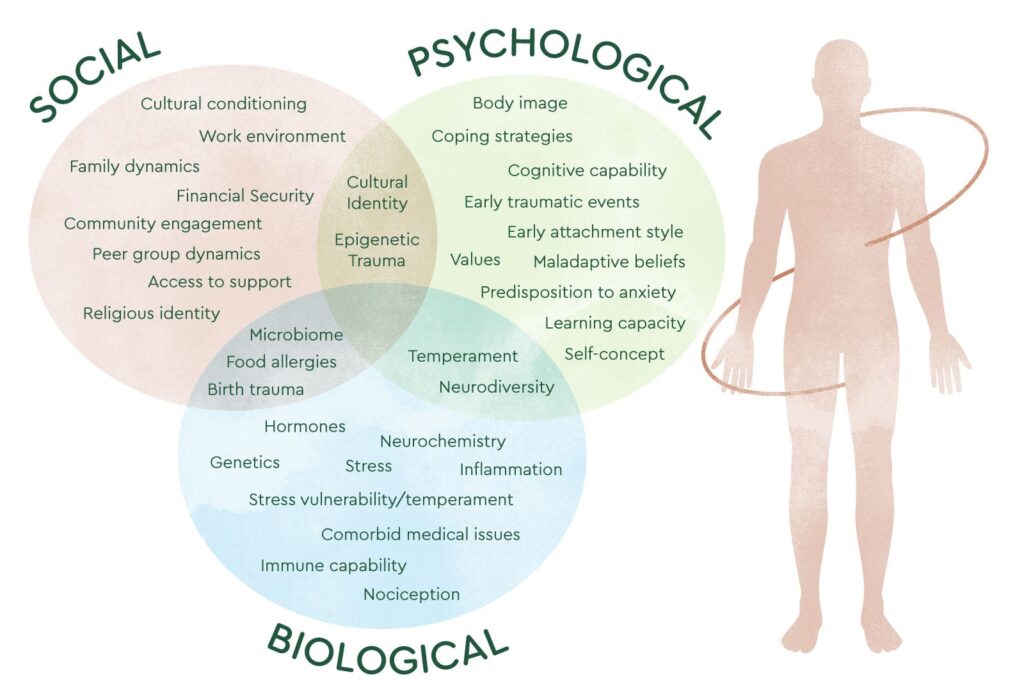
In Integrative Health Psychology, we recognize that chronic illness is rarely “just” physical or “just” psychological. It is a complex interaction of overlapping factors. To resolve a plateau, we must look at the three specific terrains where your health is held:
1. The Bio-Social Terrain: The Physical Environment
This is the foundational soil of your health. We examine how your physical body interacts with your external world and daily habits. Instead of just managing symptoms, we address the biological “noise” that prevents healing.
- Microbiome & Systemic Balance: Addressing the gut-brain axis and chronic inflammation.
- Activity & Regulation: Correcting patterns of overactivity (pushing through) or under-activity (fear-based avoidance).
- Biochemical Impact: Assessing the side effects of long-term pain medication on your recovery baseline.
2. The Bio-Psych Terrain: The Internal Wiring
This is the “communication system” of your landscape. We look at how your nervous system has become sensitized and how your biology is reacting to psychological stress.
Central Sensitization: Calming a nervous system that has become hyper-reactive to pain signals (altered nociception).
Restorative Biology: Correcting sleep and appetite disturbances that fuel chronic fatigue.
The Stress Response: Managing hormonal shifts and excessive cortisol levels that lock the body in a state of “threat.”
3. The Psycho-Social Terrain: The Relational Map
No one heals in a vacuum. This terrain explores the deeply held beliefs and attachment histories that influence how your body “braces” against the world.
- Attachment & Trauma: Resolving intergenerational trauma and maladaptive attachment styles that manifest as physical tension.
- Belief Systems: Identifying the internal “keys”—uncovering how your beliefs about pain dictate your recovery speed.
- Relational Dynamics: Addressing how your relationships and the way others respond to your illness either support your healing or keep you stuck in the “sick role.”
Why Inbody Psychology?

Clarify Your Distress
Gain insights into the often-hidden connections between your past, your emotions, and your physical symptoms or life challenges.

Holistic Mind-Body Healing
Experience integrated therapy that addresses the whole person, not just the symptoms, in areas like chronic pain, fertility, reproductive health, and relationship dynamics.

Targeted Support
Specialised guidance for understanding the mind-body link in persistent health conditions, the impact of early attachment patterns on relationships, and navigating significant life transitions.

Empowering Transformation
Discover your innate capacity for healing and create a life of greater ease, understanding, and personal power.
Diseases that can be treated with Integrative Health Psychology include:
Endometriosis
Effective treatment often requires a multi-system approach addressing hormone dysregulation (ie. oestrogen dominance), bacterial overgrowth (SIBO, dysbiosis), nutrient maladsorption and inflammatory factors as well as changing underlying maladaptive core beliefs which keep symptoms repeating or returning.
Difficult falling pregnant or repeated miscarriage
Addressing chronic inflammation, overactive immune system, nervous system dysregulation through diet and microbiome balancing. Addressing emotional blocks including ambivalence around pregnancy, limiting unconscious beliefs or attachment wounds that may inhibit conception or maintaining a pregnancy.
PCOS
Identifying the type of PCOS, addressing thyroid or liver issues, dietary changes to balance insulin. Psychologically, dealing with repressed emotions (especially anger) and limiting childhood beliefs internalised about being a woman or a fertile woman, blocked creative energy and direction in life path. Exploring re-connecting to cyclical flow of nature, the seasons, and phases of the moon as a way to organise life in line with your bodies rhythm.
Adenomyosis
Linked to deep-seated blocks in the pelvic energy. May require adjunct methods such as acupuncture, pelvic massage, visualisation techniques. Decrease excessive insulin and oestrogen, natural progesterone supplementation. Learning to listen to the innate wisdom of our pelvic energy and getting in touch with personal needs and not subjugating our needs to those of others. Learning healthy assertiveness and respect for ourselves, addressing self-worth issues.
Thyroid problems (Grave’s Disease/ Hashimotos)
A technique using bilateral stimulation (eye movements, tapping or sounds) to help process and reduce the impact of traumatic or distressing memories. It is primarily used in the cases of traumatic memory.
Chronic back/ neck/ leg pain
A body-centered (somatic) psychotherapy developed by Ron Kurtz in the 1970’s. Hakomi comes from the native American Indian Hopi language meaning: “where do I stand in relation to the many realms?”. Hakomi therapy operates on the principle that the body holds implicit memories and patterns that influence our present experience. Through gentle, mindful exploration of physical sensations, gestures, and habitual postures, clients can uncover and transform core beliefs that may be limiting their lives. It’s a very experiential and compassionate approach, focusing on non-violence and mind-body holism.
Chronic fatigue
Developed by Richard Schwartz in the 1980’s, IFS views the mind as a “family” of inner “parts” and a core “Self.” It helps individuals contact, honour and heal each of these parts to restore inner harmony and self-leadership.

About Ileana
Dr Hatton studied for 10 years at the University of Sydney. After finishing her study she worked in a variety of settings including private practice, trauma services, Crisis Team, Community Mental Health and internationally for Medecins sans Frontieres.
Ileana’s practice is also influenced by a keen interest in deeper understanding of the human experience including Buddhist philosophy, Kabbalah and Jewish mysticism, and ongoing practice in the healing modalities of 5 Rhythms Dance Therapy, Acuenergetics, and Chinese medicine.
What people say
“It’s hard to express in words how much your wise words, direction and endless encouragement have helped guide me through these past few years. It has been a challenging and fulfilling period of personal growth for which I am most grateful. I do feel I’m on the right path and more determined than ever to keep at it. Thank you Ileana for your gentle and gracious manner.”
“Thank you for being such a significant part of my journey, for steadily unpacking my pain with me and for helping me be still long enough to find ME again- mind, body, heart and soul. With your help my smile became a giggle, and is steadily heading for a full-on belly laugh!”
Frequently Asked Questions

What's the difference between a Psychologist, a Clinical Psychologist, and a Psychiatrist?
One of the most widely researched evidence-based therapies, CBT focuses on changing unhelpful thought patterns and unwanted behaviours to improve functioning and well-being.
Do I need a GP referral to see a clinical psychologist?
Instead of trying to control or change difficult thoughts and feelings, ACT helps individuals learn to accept them and shift focus to committed action towards their goals and values. It uses metaphors, mindfulness, and experiential exercises to help clients live a rich and meaningful life by fostering psychological flexibility.
What can I expect from a therapy session?
A behavioural approach that focuses on balancing emotional dysregulation through skills training in 4 different areas: mindfulness, distress tolerance, emotional regulation and interpersonal effectiveness. It is the gold-standard of treatment for Borderline Personality Disorder but has also shown effectiveness for addictions, eating disorders, self-harm behaviour and ADHD.
Do you see people under Worker’s Compensation?
Addresses deeply rooted, long-standing core beliefs (schemas) formed in childhood, helping individuals understand and change how these patterns impact their lives today.
How many sessions do I need?
A technique using bilateral stimulation (eye movements, tapping or sounds) to help process and reduce the impact of traumatic or distressing memories. It is primarily used in the cases of traumatic memory.
Can I get sessions under insurance?
A body-centered (somatic) psychotherapy developed by Ron Kurtz in the 1970’s. Hakomi comes from the native American Indian Hopi language meaning: “where do I stand in relation to the many realms?”. Hakomi therapy operates on the principle that the body holds implicit memories and patterns that influence our present experience. Through gentle, mindful exploration of physical sensations, gestures, and habitual postures, clients can uncover and transform core beliefs that may be limiting their lives. It’s a very experiential and compassionate approach, focusing on non-violence and mind-body holism.
I’m not an Australian citizen, can I still access sessions?
Developed by Richard Schwartz in the 1980’s, IFS views the mind as a “family” of inner “parts” and a core “Self.” It helps individuals contact, honour and heal each of these parts to restore inner harmony and self-leadership.